Is Bike Commuting the Ultimate Longevity Hack?
- Dates: 2026-10-17 – present
- Status: unfinished
- Importance: 7
I think bike commuting is so great. In Boston, it’s often faster than walking or waiting for transit or Uber (and cheaper). It also just feels great to get up from my computer, breathe in the fresh air outside, and use my legs as I pass by the beautiful Charles River or bustling Huntington Ave (this video captures some of the feeling):
I’ve always felt in my gut that it’s also great for health. Bike commuting enforces regular exercise, which can be hard to motivate otherwise. I recently felt validated on this after seeing a 2024 study of ~82k Scottish individuals that found that, over 18 years, cyclist commuters had half the rate of death compared to those commuting by car or transit. The substantially lower rates of heart disease, cancer, and mental health issues outweighed the slightly increased risk of traffic injuries. (Note: other studies have found lower but still positive associations between bike commuting or biking and health outcomes like all-cause mortality, so “ultimate longevity hack” is probably too strong a claim. Different studies have tried to handle correlation vs. causation, definitions of “biking” and “bike commuting,” etc. differently, which can explain the variations of results. Nonetheless, the consistency of positive associations struck me.)
So at a time when many are embarking on the noble but difficult quest of finding medical treatments for Alzheimer’s, whereas we know that physical inactivity is a risk factor for dementia, why not also think about ways to increase exercise via bike commuting?
Barriers to bike commuting
I see a few key barriers:
- Obviously some commutes (I’d say longer than 7 miles one-way for non-electric bikes) are too long to feasibly do by bike everyday.
- Then there are some of the hassles of bike ownership: acquiring, maintaining, and safely parking a bike.
- Another is safety, both actual and perceived. Some destinations genuinely lack safe routes to get there; others have safe routes, but beginning bikers are not comfortable biking on the same road as cars.
- Some people are worried about arriving sweaty/messy to work.
- Some people don’t like biking in the heat (summer) or cold (winter).
Solutions: bike share programs and infrastructure like bike lanes
Cities like Boston and San Francisco have invested quite a bit in (a) bike share programs like BlueBikes and Lyft Bike, (b) bike infrastructure like lanes and racks, and (c) outreach to promote and educate on biking adn bike maintenance. I think these address factors 2 and 3, respectively:
- Bike share allows new bikers to start biking without going through a lot of hassle.
- Bike lanes are one of the major ways to increase perceived (and potentially actual) safety.
- Bike outreach is a meta-program that prompts people to take advantage of (a) and (b).
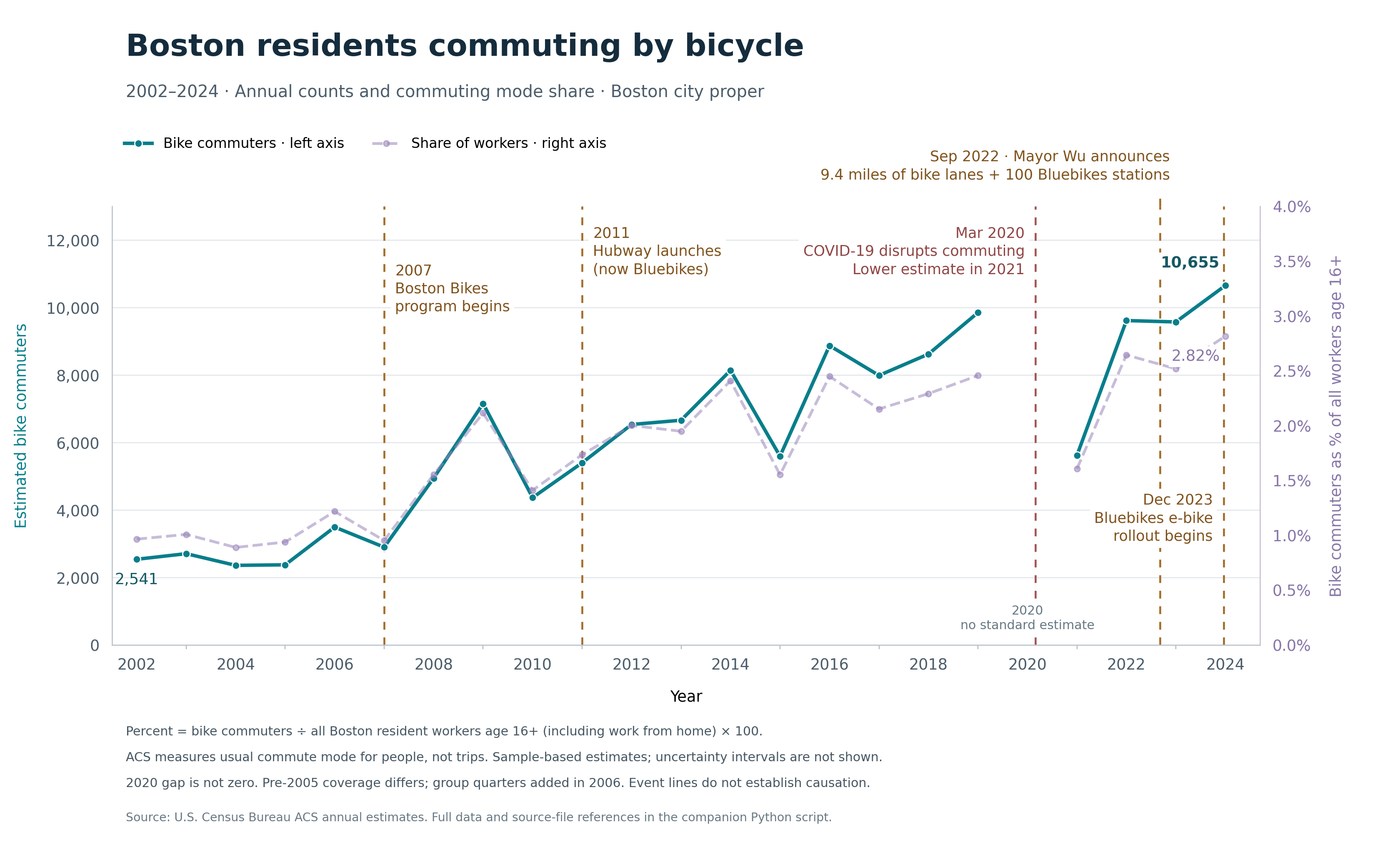
I think we can give these initiatives decent credit for the result that the number of Boston bike commuters has increased from 4,400 in 2010 (a few years after the city’s Boston Bikes initiative and just before BlueBikes began in 2011) to 8,100 in 2014 and 10,700 in 2024 (see below). At the time of this writing, Bluebikes riders have taken more than 32 million total trips across the Greatest Boston area!1
Solutions: sweatiness and temperature
My opinion is barriers 4 (sweatiness) and 5 (heat/cold) above are not a big deal in cities with climates like Boston and San Francisco. I typically sweat a lot but, by putting some thought into my riding clothes each morning, I avoid sweating much on the ride. Often I’ll wear a long-sleeve shirt, shorts, and maybe a hoodie in 55-degree weather (yes shorts – the legs heat up more quickly than you’d expect). If I need to wear long pants at work, I roll up the long pants during the ride as pseudo-shorts, and I roll them back down when I get to work. I also adjust my clothes during the ride. If my upper body is feeling hot, I’ll unzip the hoodie, or even pause the ride on the sidewalk to take the hoodie off and put it in my bag or drape it around my shoulders like a cardigan.
Correspondingly, I put on more layers when riding in Boston’s colder weather. I usually wear gloves when it’s below ~50 degrees. I also wear a balaclava when it gets below 40 degrees (otherwise my ears hurt from the stinging cold). If one layer of pants isn’t thick enough, I wear long underwear underneath.
It might sound complicated, but honestly it’s barely different than the layering that New Englanders and others have done their whole lives. (You Californians luckily don’t have to deal with this; you can probably figure out one outfit that fits you for most of the year.)
Looking forward
Despite this growth in bike commuting, there’s still a lot of room to grow. Only ~3% of Bostonians commute by bike, despite the fact that 50% of those who work in Boston have one-way commutes of less than 8.4 miles, which in theory are doable in 25 minutes by e-bike.2 (This stat, however, is as the crow flies rather than actual road distance, and there may be reasons that bike lanes or other changes can’t cost-effectively make biking the preferred transit mode for certain routes. On the other hand, the disparity between 3% and 50% suggests significant room to grow.)
I know less about the situation in other cities. I can imagine three types of cities:
- cities where biking is already attractive, easy, and safe;
- cities that are reasonably dense (jobs are reasonably close to housing) but are still hard for biking due to infrastructure/safety concerns; and
- cities that are spread out and would require more compact development over an extended period of time to make biking more attractive.
Cities like Miami and New Orleans might fall into category 2 because they are reasonably dense yet have a reputation for unsafe biking. Despite the unsafe reputation, they’ve still had millions of rides in their bikeshare programs; imagine how many more there might be if those cities invested in safer biking infrastructure.
Even cities in category 3 can get creative by promoting e-bikes, which can enable commutes that were previously infeasible by non-electric bikes. They would need to accompany this with bike lanes/routes that connect places of work and living; for example, Houston has gotten creative with their Bayou Greenways initiative which creates bike routes separate from normal car-heavy roads.
I’m not saying all commute needs to be done by biking. Walking seems great; transit is great too. But knowing how much fun biking is, and remembering the Scotland study on its health impacts, I feel like every bikeable commute taken by car (or another non-active mode) is a lost opportunity.